$120.00

 from
$84.00 USD
$145.00 USD
from
$84.00 USD
$145.00 USD


 Sold Out



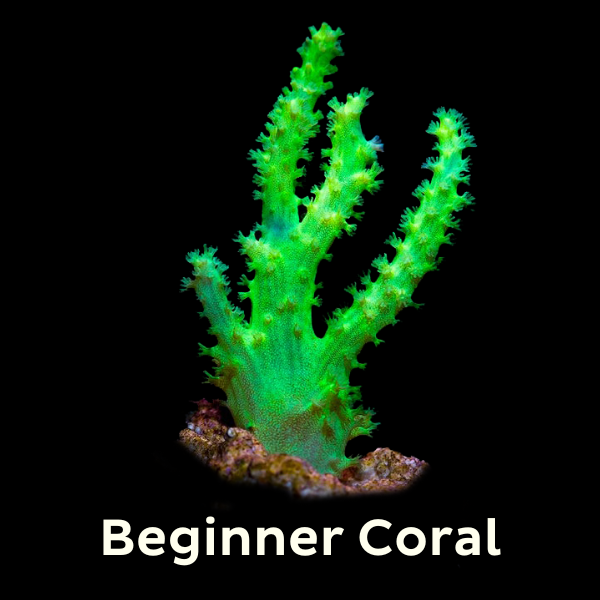
When setting up a home reef aquarium, finding corals that are easy to care for, visually stunning, and adaptable can be challenging. Biota Palau cultures some of the most popular choices among aquarists, both novice and experienced - the Sinularia genus, a group of soft corals known for their beauty, dynamic movement, resilience, fast growth, and manageability. Sinularia's affordability and durability makes it one of the best first corals for beginners or new reef tanks.

Why Sinularia is Ideal for Your Aquarium
1. Hardy and Beginner-Friendly
One of the standout features of Sinularia is its resilience. These soft corals are highly adaptable to a wide range of water conditions, making them an ideal choice for those new to reef keeping. Even if you're still learning the ropes of maintaining water chemistry, lighting, and flow, Sinularia can thrive in your tank. While many corals require precise environmental parameters, Sinularia can tolerate small fluctuations in water chemistry.
2. Fast-Growing but Easy to Manage
If you're looking for a coral that grows quickly without overwhelming your tank, Sinularia is a perfect fit. Unlike other fast-growing soft corals like Xenia or green star polyp which can take over your aquarium, Sinularia grow from a stalk instead of spreading on surfaces in your tank. It responds well to pruning and propagation, meaning you can trim back your coral if it starts to spread, and even grow new colonies from those trimmings to trade with your friends.

Sinularia can grow very large and make impressive centerpieces in a reef
3. Stunning Movement and Appearance
In addition to their hardiness, Sinularia corals are renowned for their aesthetic appeal. With long, flowing finger-like lobes, these corals create beautiful, swaying motions in the water current, mimicking the natural rhythms of ocean tides. Their soft, leathery texture contrasts with the rigid structure of hard corals, offering visual variety to your tank.
The colors of Sinularia can range from cream, tan, and pink to mint green and neon green, depending on the species/variety and environmental factors. The way they reflect light and sway in the water makes them a captivating centerpiece for any aquarium.
4. Self-Sustaining Symbiosis
Like many other corals, Sinularia have a symbiotic relationship with zooxanthellae, microscopic algae living within their tissues. These algae perform photosynthesis, providing nutrients to the coral. This means you won’t have to feed Sinularia as frequently as you would some other coral species. With the right lighting, the coral’s symbiotic algae will take care of most of its nutritional needs.

Care in the Home Reef Aquarium
Sinularia corals are hardy and adaptable to a wide range of water conditions. However, for optimal health, aim for the following water parameters:
Temperature: 74°F - 78°F
Salinity: 1.023 - 1.025
pH: 8.1 - 8.4
Alkalinity: 8-12 dKH
Regular water changes and monitoring are key to keeping your coral vibrant and healthy. Though Sinularia can handle some fluctuation in water quality, stable conditions promote better growth and color.
Lighting Requirements
Sinularia corals primarily rely on their symbiotic zooxanthellae for nutrition, which means they need adequate lighting for photosynthesis. Moderate to high lighting is ideal, but Sinularia can adapt to lower light conditions as well. LED lights, metal halide, or T5 lights for reef tanks work well for Sinularia, but be sure to properly acclimate your coral to new lighting to prevent bleaching.
Water Flow
Moderate water flow is essential for Sinularia corals. Proper flow helps keep the coral clean by preventing detritus from settling on its surface and ensures adequate nutrient exchange. Avoid direct, high-intensity jet currents that will prevent the coral from opening. Wavemakers and Gyres are great tools for creating proper water currents in the reef aquarium.
Feeding
While Sinularia corals get most of their nutrients through photosynthesis, they can also benefit from occasional supplemental feedings. Offer planktonic foods like Easy Reefs Easy Booster and Easy SPS Evo. This is especially useful in low-light setups where the coral might not be getting enough energy from photosynthesis alone.
Shedding
Don't be alarmed if you see your Sinularia close and shrink suddenly for an extended period of time, up to 2 weeks. Sinularia corals sometimes shed a waxy outer layer of skin as a natural process to remove built-up debris, algae, or other irritants. This shedding helps the coral stay clean and healthy, allowing it to maintain optimal photosynthesis and nutrient absorption. During this process, the coral may temporarily appear dull or less vibrant, and may even have some algae growing on it, but once the shedding is complete, it regains its full color and vibrancy. Make sure adequate water flow surrounds the coral to help the shedding process, which is a normal behavior and isn't an indication that the coral is unhealthy.

a Biota Radial filefish makes a home in @shakerbreakersreef Biota Sinularia
Species and Varieties
There are 38 different species of Sinularia in Palau alone! Biota Palau cultures some of the most beautiful and sought after varieties.

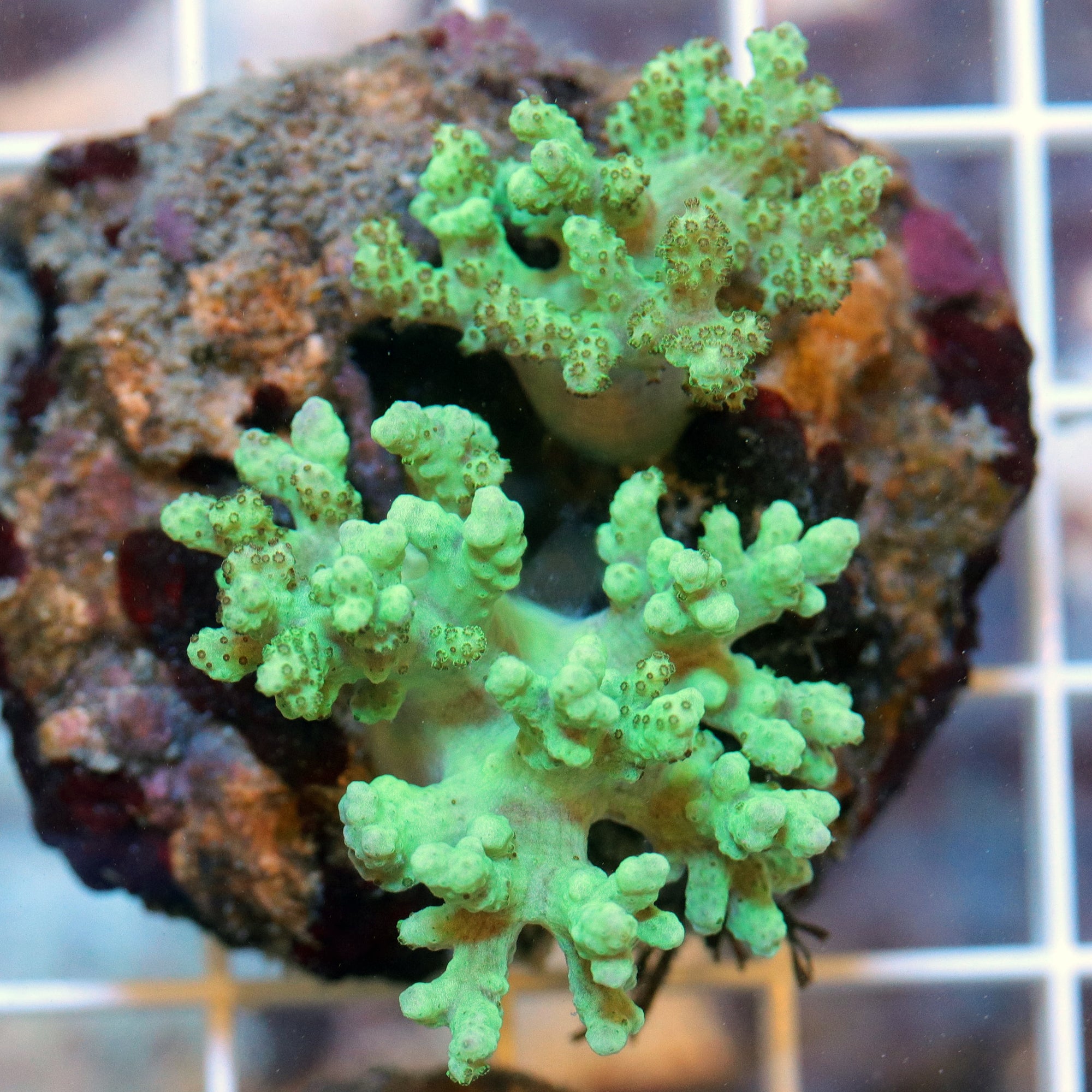
Biota Palau Alien Hands Sinularia aka "Neon Green Nephthea"
This variety is arguably one of the most important, iconic, and brightly colored aquarium corals in the world. Not only does it possess all the best qualities of the hardy Sinularia, making it great for beginners, but its bright neon coloration is second to none, which endears it to seasoned coral collectors, as well. Its extreme coloration is present even in daylight, but under actinic lighting, this coral fluoresces like no other coral. If you keep this variety in your home aquarium, it's often the first thing visitors will notice due to its intense coloration.
In the early 2000s, this species was called "Neon Green Nephthea," but it is actually a species of Sinularia. Eric Borneman explained in "Mythical Rare Green Tree" that a devastating bleaching event at the main collection site in Palau in the early 2000s led to the rumor that the coral was extinct in the wild, which made it difficult to source and even more popular. The "Neon Green Nephthea" was believed to only exist in the "ark" of captivity. This inspired aquarists to make it one of the most widely propagated and distributed corals among home reefs. Thankfully, this variety has made a good recovery in Palau, and Biota Palau has been offering fully cultured specimens for many years. We choose only the brightest, most fluorescent specimens for this variety.


Biota Palau Fuzzy Fat Finger Sinularia
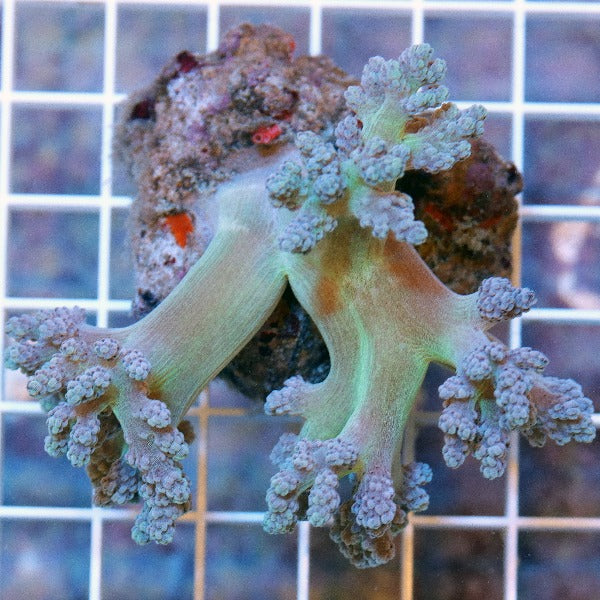
The Biota Fuzzy Fat Finger Sinularia has a more subtle coloration - some are cream, almost white, and some are a softer green, giving a nice contrast to the saturated colors of other corals in our tanks. Instead of the thin, spaghetti like lobes of the Alien Hands Sinularia, The Fuzzy Fat Finger Sinularia has thicker, stubbier lobes with many compact, fuzzy polyps, giving it a softer appearance. Biota customers call this coral "completely bulletproof," so it makes an excellent choice for beginning aquarists.


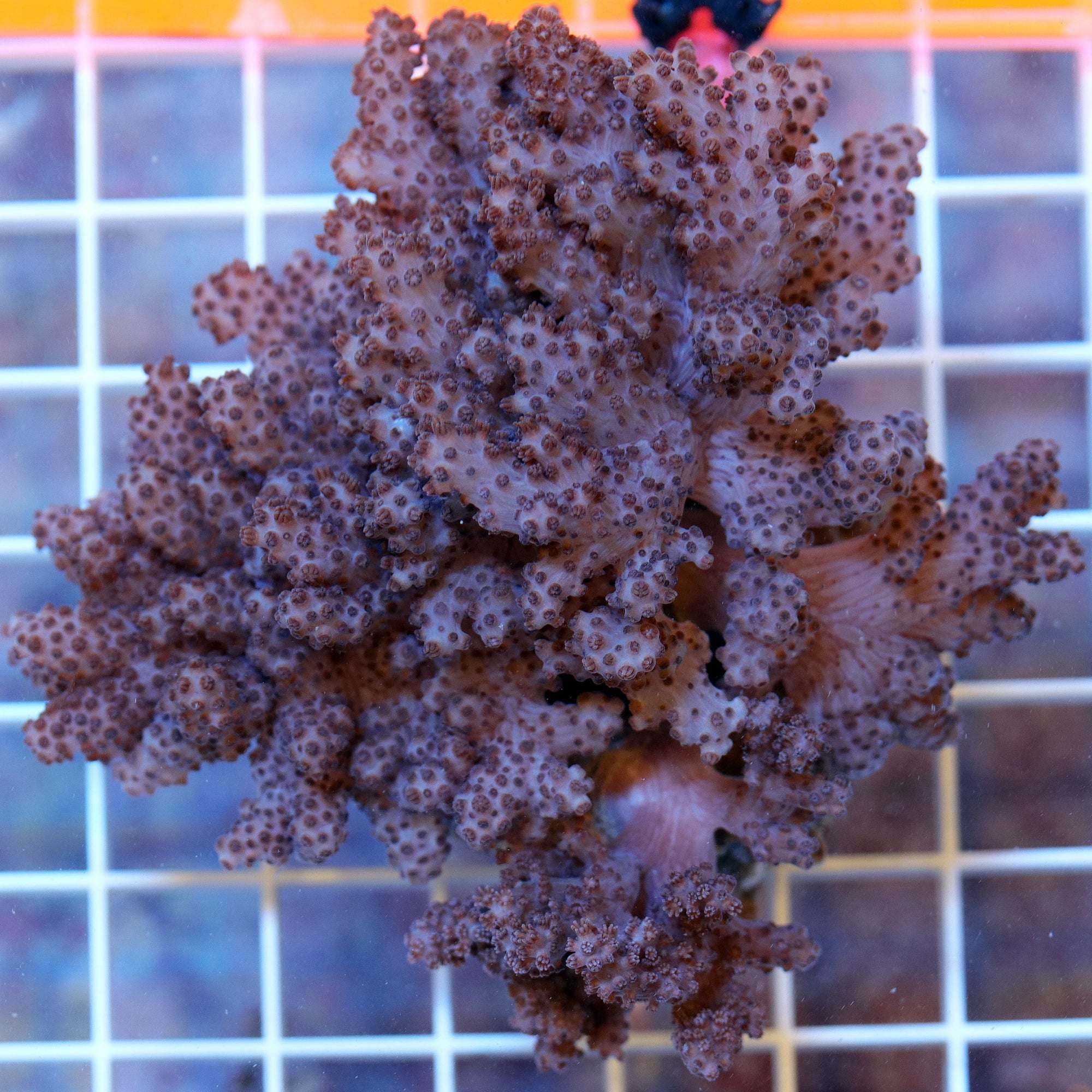
The Cabbage Leather Coral (Sinularia brassica) is an incredibly hardy and attractive coral. Instead of growing fingers like other Sinularia, the Cabbage Coral grows thick, ruffled, cabbage-like "leaves" which adds unique texture and visual appeal to aquariums.

Compatibility
Sinularia corals contain a toxin that slows the growth of more sensitive SPS corals like Acropora. To prevent this, provide plenty of space between Sinularia and Acropora, and employ chemical media in the filtration, such as a media reactor, to help alleviate allelopathy.
Taxonomy and Identification:
With DNA technology, marine taxonomists have made strides in better understanding the genetic relationships between coral species. One significant update involves the reclassification of several species traditionally categorized under Sinularia into the genus Sclerophytum in 2022 (1.). This shift was driven by deeper genetic analysis, which revealed distinct differences between certain species of soft corals that had previously been lumped together.
In the early 2000s, many reef aquarists referred to Sinularia finger leather corals as Nephthea, a soft coral genus that shares certain visual similarities with Sinularia. However, this naming was incorrect, and today, hobbyists and marine professionals have a better understanding of the distinction between these two genera.

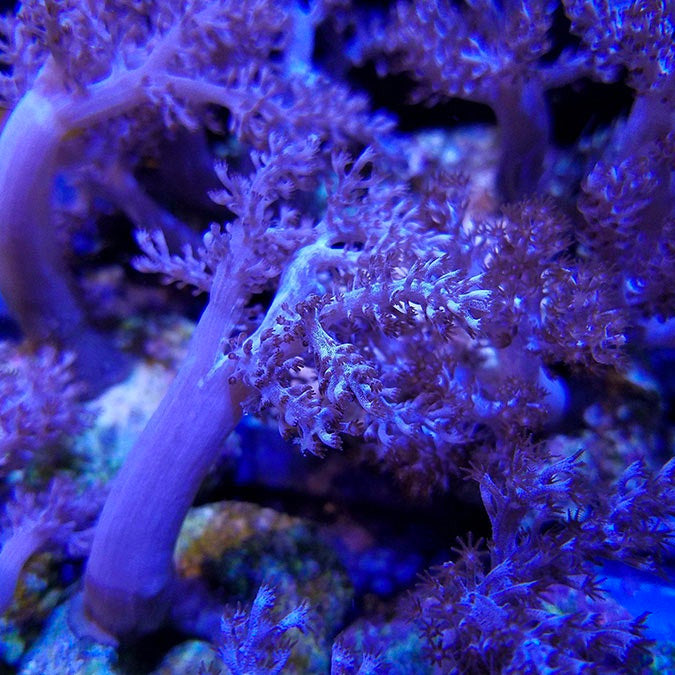
a true Nephthea
Though both Sinularia and Nephthea are soft corals from the family Alcyoniidae, they have distinct differences in morphology and behavior. Here’s how you can tell which coral is which:
1. Colony Structure and Shape
The most noticeable difference between Sinularia and Nephthea lies in the structure of their colonies. Sinularia species typically have thicker, more robust branches, often resembling a leathery tree or bush. These branches tend to be broader and sturdier, giving the coral a more substantial appearance.
In contrast, Nephthea corals have much finer, more delicate branches. Their structure is often described as feathery or fuzzy due to the thinness of the branches and the density of polyps. The polyps are closer together, giving Nephthea a more intricate and textured look, while Sinularia’s polyps are more spaced out, contributing to its smoother appearance.
2. Polyp Size and Behavior
The polyps of Sinularia are typically smaller and more retractable, giving the coral a cleaner, smoother look when the polyps are withdrawn. You might notice that Sinularia polyps often remain retracted during changes in lighting or flow, making the coral appear as though it has a leather-like surface.
Nephthea, on the other hand, tends to have larger, more prominent polyps that give it a more "fluffy" or textured appearance. Even when retracted, Nephthea polyps don’t fully disappear into the coral’s surface, making it look more tactile and busy compared to the smoother look of Sinularia.
3. Flexibility and Movement
While both corals sway gracefully in the current, Nephthea corals are more flexible due to their thinner branches. This allows them to move more fluidly in the water. Sinularia corals, with their thicker branches, are still responsive to water flow but tend to exhibit a sturdier, more controlled movement.
4. Texture and Sclerites
Another key difference is in the internal structure of the corals. Both Sinularia and Nephthea possess sclerites—small, calcareous spicules that give their tissues structure. However, Sinularia has more prominent, firmer sclerites, which give its branches a slightly stiffer texture compared to the softer, more pliable feel of Nephthea. Nephthea has an overall slimy, softer feel than the leathery texture of Sinularia. The base of Sinularia is packed with these hard sclerites, which feel hard, rough, and sometimes sharp when the base is handled.
For home aquarists, knowing the difference between Sinularia and Nephthea is more than just a matter of correct identification. Sinularia’s hardier, more robust nature makes it better suited for beginners, while the more delicate Nephthea require more precise water conditions, stronger water flow, and stronger lighting.
For aquarists looking to enhance their home reef tanks with hardy, fast-growing, and visually appealing soft corals, Sinularia from The Biota Group are an excellent choice. With their graceful movements, easy-care requirements, and controlled growth, Sinularia corals provide all the benefits of a dynamic coral without the risks of overgrowth like other fast-growing species.

ref: 1. McFadden, C.S.; van Ofwegen, L.P.; Quattrini, A.M. (2022). Revisionary systematics of Octocorallia (Cnidaria: Anthozoa) guided by phylogenomics. Bulletin of the Society of Systematic Biologists. 1(3), 8735, pp. 1-79., available online at https://ssbbulletin.org/index.php/bssb/article/view/8735
page(s): 45 [details]
Want to learn more about the person who manages Biota's Hawaii aquaculture facility? James Gorke holds degrees in business management and aquaculture technologies. With over 10 years of experience, James cultured more than two dozen species of marine fishes and invertebrates. James further enhanced his qualifications through certifications from AALSO (Aquatic Animal Life Support Operators). James has also contributed to the academic world as an adjunct professor at Carteret Community College teaching Hatchery Management labs and classes.
During his tenure at CCC, James conducted research on blue crab rearing for food aquaculture. James also played a role in the establishment of Biota NC alongside his mentor Todd Gardner. James then ventured to Hawaii to manage Biota HI, a testament to his leadership skills and expertise in marine biology. His passion and expertise contributes to Biota's mission of promoting sustainable aquaculture practices and preserving our precious marine ecosystems.
Not only is James great at managing our Hawaiian facility's fish production, he has a quirky sense of humor that brings some sunshine to the Biota family every day. For his birthday this year, we knew we had to get him a gift that is as fun and silly as he is. We put our heads together and decided on this mug design, which is available on the Biota website.


Can you tell us what made you choose marine ornamental fish breeding as a passion and career?
Back when I was a teenager I became fascinated with aquariums. The beautiful animals cruising through the water with grace always had a comforting and calming presence. Whether it was planted tanks or reef tanks, having a tank to watch after a long day at work was such a nice way to break away from the hustle and bustle of busy life and enjoy a little slice of paradise in the comfort of my own home. I tried to share this passion with all of my friends and every customer that I would interact with at the pet stores I worked at. It wasn't just the visual beauty that held my attention, it was the unseen ecosystem that kept the balance of a healthy tank that really piqued my interest. My path into aquaculture began the same way most hobbies become jobs.As a broke highschooler and a similarly broke college student I realized that my passion for aquariums was bigger than my wallet was. Having an expensive hobby and little self control at the store are a bad mix so I needed to find a way to have my hobby support itself. I started by growing freshwater plants and shrimp as well as a few beginner corals and trading them to local stores for credit. This realization that it was possible to farm these organisms for some sort of value got me thinking about how to scale this to something that could actually support itself. Another important factor that drove me towards captive breeding was the difference in the animals themselves. When you work in a petstore, receive shipments of animals, and visit wholesalers you really start to see how tragic the health can be in wild caught fish. It wasn't uncommon to see entire shipments of fish come in completely covered in disease or to receive boxes of fish that you knew were no longer swimming before you even opened the box. It was heartbreaking to say the least. Meanwhile we would receive captive bred clownfish, seahorses, dottybacks, etc and rarely see that sort of thing. Not only were they usually healthier, but they were also excited to see me when the box was opened and the light shined in. While the wild caught fishes hid behind decorations and didn't want to eat, the captive bred fish would leave their bags and immediately come to the glass to watch me and beg for a snack. The personality of a fish really comes out when they are comfortable and see their humans as caretakers and food providers, rather than as abductors. I think everyone who has had a fish for a few years can attest to that. The captive bred fish almost always acted more like puppies than fish. My love for these animals and their well being really put aquaculture as a necessary path forward for the industry in my mind and set me on the path I've been walking for so long now.

What successes are you most proud of in your career?
There is so much I'm proud of in my career. Being here in the first place is definitely one of them. The ability to do what I love for a living is an amazing blessing that I can't overstate, and I owe that entirely to the amazing customers we have that support us and allow us to do what we do. It's an amazing feeling and I'm so grateful to everyone who has a Biota fish in their home. Of course I have some species I'm most proud of too. Working with Todd Gardner in North Carolina to bring his dreams of Cuban Basslets and Flathead Perch into a larger production and availability is definitely a big one. Personally, all of my reef tanks have been relatively small so my dream species always reflected this. I'm so grateful to have been able to provide the world with captive bred Royal Grammas and most recently Flame Angelfish. In all honesty though, the thing that makes me the most proud is seeing the animals we raise in their forever homes. It doesn't matter what fish it is, when I see photos, videos, or even comments and emails from customers about their Biota fish it makes me so happy. It brings me back to my days as a home aquarist. I know that every one of those animals is being watched, cared for, and loved by someone and that the work we do is improving the lives of our customers. Sometimes when we are working it's hard to see the forest for the trees. We love our fish but they aren't our fish. They are YOUR fish, and no matter how much we love them we know that you will love them even more because they are special to you. That is what really drives me to keep going in this industry. Everytime we get a message or photo of a fish we raised I like to show it to our team as a reminder of why we do this and how much impact the work we do has on people all across the world. I love seeing these come in, so if you have some of our fish I encourage you to send us something like this. It always brightens our day to see.

Biota captive bred tang "Lello" owned by aquarist Jocelyn Wilson
What species do you dream of breeding in the future?
There are plenty of projects in the works and lots of progress to be made. I won't spoil any surprises or attempt to predict the future. In my wildest dreams I would love to see myself breeding pufferfish, box fish, burfish, etc. The little goofballs with tiny fins and huge personalities. My favorite fish I ever owned was a pufferfish. I called him Porky Gorke, the porcupine puffer. I loved that fish so much. He was so entertaining, friendly, and smart. Porky Gorke left such a lasting impression on me and despite life changes requiring me to rehome him as I moved across the country, I have never forgotten his big smile and bright eyes.

When you’re not breeding fish, what do you like to do?
Well, to be honest I like to work. I spend a lot of my free time working as well. Whether it's planning systems, designing protocols, communicating with our awesome partners and colleagues. When I do take a few moments to myself I like to play video games, go on walks with my wife, and cook.

Any advice for aspiring fish breeders?
There are a million ways to get into the industry. Whether it's as a hobby, a side hustle, or a career. I recommend hobbyists who want to get started try to plan out a fish room, or maybe a second fish room specifically for breeding. There are lots of good resources online and in books. "The Complete Illustrated Breeder's Guide to Marine Aquarium Fishes" by Matthew Wittenrich was one of the books I read early on that really breaks down some of the basics and is a great bridge for a hobbyist aquarist to a hobbyist breeder. If you are interested in more in depth education and hands on experience it might be worth looking into finding a school near you that specializes specifically in Aquaculture. Carteret Community College in North Carolina is a fantastic example. If you are passionate about aquaculture, an education at CCC from Dave Cerino and Todd Gardner is well worth it. Above all, a strong work ethic and a passion for what we do will take you farther than anything else. This industry is very niche so getting your foot in the door and picking up a little experience somewhere will make a bigger difference than you think.